The Change You Didn't Choose Still Has To Be Led



What the Berlin Wall and Gibraltar Can Teach Us About Collective Change. This piece continues a reflection I began in an earlier article, “The Four Conditions: What the Berlin Wall Can Teach Us About Collective Change.” This time, the same four conditions are held up against a very different kind of change; one that arrived without anyone choosing it. It compares the Berlin Wall with Gibraltar's border opening to reveal two very different patterns of change; one built from collective capacity, one imposed first with the capacity still owed and what that asks of leaders either way.
Sixty-nine percent of people are willing to sacrifice part of their income to address the climate crisis.
Sit with that for a moment.
That is not a small minority of committed activists. That is a majority sufficient for collective will to create significant and lasting change.
And yet, the gap between that willingness and coordinated collective action remains vast. Not because people don't care, because the evidence is unclear, or because the challenges are not real.
The gap exists because willingness, however widespread, does not automatically become action. It requires conditions, and those specific conditions; relational, structural, and organisational are rarely deliberately built.
Therefore, this is not a motivation problem but a systems design problem. And until we name it as such, we will keep reaching for the wrong solutions, usually grounded in structures or processes which are the superficial layer.
Look closely enough at almost every organisation, and this pattern becomes visible everywhere.
Across organisations, individual capability is often high, people are talented, informed and genuinely committed. People care about the work and about the people they work with.
And yet collective performance, the ability of a system to think, sense and act together in response to complex, interdependent challenges consistently falls short of what the individual parts would suggest is possible.
Teams that should be generative become transactional. Organisations that aspire to be adaptive default to the familiar; complex challenges approached from problem-solving mode and the same thinking that contributed to the challenge occurring. Leaders who know that something needs to change often find themselves reproducing the very dynamics they are trying to shift.
The instinct is to look for individual explanations and often blame. The wrong leader, a difficult team member, the cultural legacy of a previous era. Although sometimes those things are relevant, more often, what is missing is not better individuals. What is missing is the relational and systemic infrastructure that allows individuals to become something more than the sum of their parts.
Nowhere is this more visible than in the moments history changed.
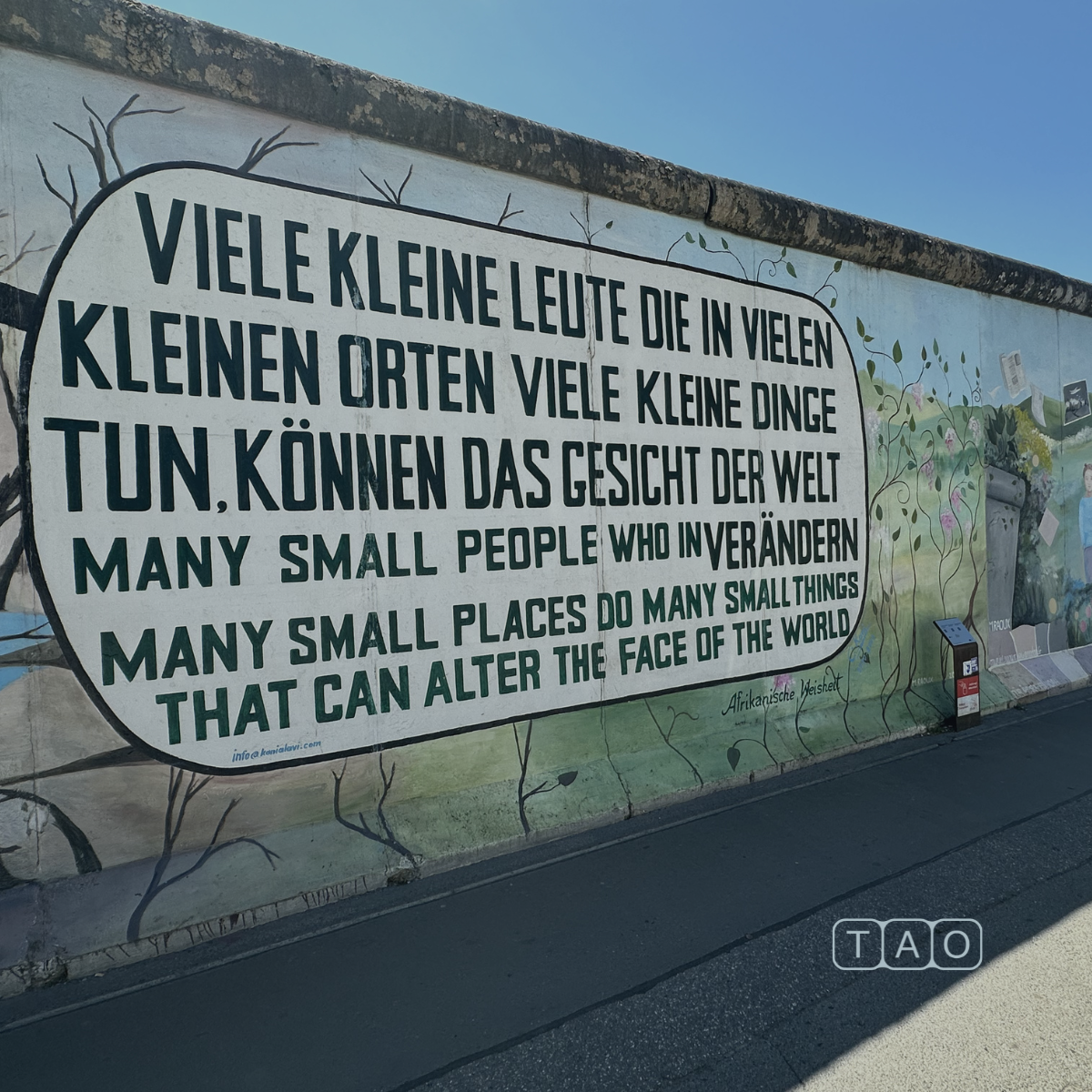
On the evening of 9th November 1989, a spokesman for the East German government misread an announcement at a press conference. Within hours, crowds had gathered at the checkpoints. Guards, receiving no clear orders, stood down and people began to cross.
What followed was the reunification of Germany, the dissolution of the USSR, and the reshaping of the European order was one of the most profound geopolitical shifts of the twentieth century. Triggered, in the immediate sense, by a bureaucratic error.
But the immediate trigger obscures the deeper story. Because what actually fell that night was not primarily a wall. It was a set of conditions that had been building, quietly and collectively, for years.
Four conditions, specifically.
The first is that the consciousness of the system had to change. Not the behaviour and not the output, but the underlying assumptions about what was permanent, what was possible, and what was inevitable had to shift. And they did slowly, through the peace prayer meetings in Leipzig, through Solidarity in Poland, through Gorbachev's willingness to loosen the grip of Soviet orthodoxy. People stopped believing the regime was immovable and some inside the regime began to doubt it too.
The second is that the system had to be able to see and sense itself. The Monday demonstrations in Leipzig with 70,000 people in the streets by October 1989, made the system's own contradictions visible to itself in a way it could no longer suppress. Citizens saw each other's courage reflected back and the regime saw its own fragility. That mutual visibility changed what felt possible.
The third is that the system had to sense and embody the future before it was confirmed. The people who showed up at the checkpoints on the night of November 9th had no guarantee of safety, no authorisation and no certainty. They moved toward a possibility they could sense before it was real. That embodied anticipation by thousands of people acting as if the future had already shifted is what made it shift.
The fourth is that none of this was possible without support structures. The church networks, and particularly the Nikolaikirche in Leipzig, provided the relational and physical infrastructure where people could gather, sustain each other, and build the collective capacity to act. The structures did not create the movement. But they held the conditions for the movement to emerge and align.
No single condition was sufficient. Each depended on the others. And when they converged even briefly and imperfectly, what became possible defied what anyone had thought was realistic.
Almost four decades later, and at the southern end of the continent, a different wall came down and it tells a very different story.
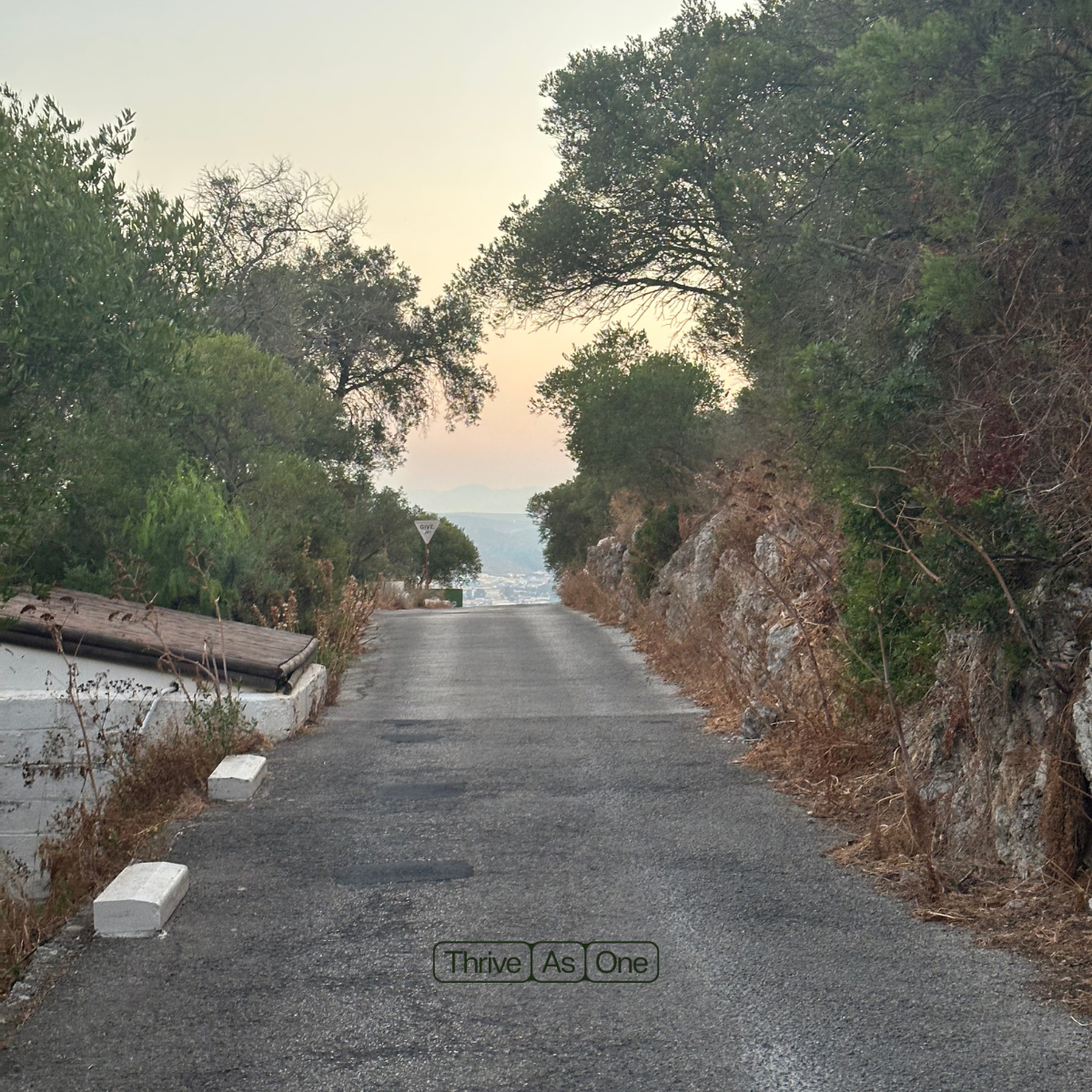
At midnight on 15th July 2026, a fence that had stood for 118 years came down. The border between Gibraltar and Spain, closed and controlled in various forms since long before either country's current governments existed, simply opened.
On the surface, it looks like the same story as Berlin. A hard structural barrier, decades old, gone almost overnight.
But look closer and the sequence runs in reverse.
In Berlin, the wall fell because the conditions had already shifted. The system had learned to see itself. People had already begun acting as though the future had arrived, before anyone confirmed it had. The wall was the last domino, not the first.
In Gibraltar, none of that happened first. The fence came down because of a treaty which arose out of four years of negotiation between the EU, the UK, Spain, and Gibraltar's government, closing the final unresolved question left over from Brexit. And Brexit itself was a vote Gibraltar didn't choose. Ninety-six percent of Gibraltarian's voted to remain in the EU. They were taken out of it anyway, by a referendum decided almost entirely by people who don't live in Gibraltar and will never cross that border.
There was no Leipzig moment and no months of Monday demonstrations building mutual visibility. No crowd sensing a different future and moving toward it before anyone could confirm it was safe. The structural change simply arrived; negotiated, signed, and executed by people other than those who now have to live inside its consequences.
This is a different pattern entirely. Not collective capacity producing structural change, but structural change landing first, and collective capacity now owed.
The fence is gone. The shift in collective capacity, the mutual visibility, the embodied sense of a different future, the support structures to hold it all; none of that has necessarily arrived yet. It has to be built now, by a population that didn't choose the change. Whether the four conditions ever catch up to the structure that's already been imposed is, as of today, an open question.
And this pattern, not Berlin's, is probably the more familiar one inside most organisations. Very few structural changes such as a merger, a reorg, a new operating model, a return-to-office mandate arrive because collective capacity converged first. Far more often, the structure changes because someone with authority decided it should, and the people now living inside it are left to build the conditions afterwards; to make sense of it, to see each other clearly again, to sense what future is actually possible now, to find or rebuild the support structures that let them do any of that work together rather than alone.
Berlin shows what collective capacity can produce. Gibraltar shows what happens when the structure moves first and the capacity is still owed.
Taken together, these two moments reframe what we usually assume about collective change.
We tend to think of collective change as the aggregation of individual actions. Enough people doing enough things, adding up to something significant.
Berlin and Gibraltar, together, suggest something different and more complete than either alone.
Berlin shows collective change as emergence: what becomes possible when a system develops the capacity to see itself, sense a different future, and act in concert, held by structures that make sustained connection possible.
Gibraltar shows the same four conditions from the other direction, not as the cause of structural change, but as the debt left behind by it. The structure moved, but the conditions did not move with it. They now have to be built into a change that has already happened.
This distinction matters enormously for how we think about organisations, because most organisational change still looks far more like Gibraltar than Berlin.
Most organisations are still not designed for emergence. They are designed for coordination; the efficient alignment of individual effort toward defined outputs. That design made sense for a certain kind of challenge. It makes far less sense for the complex, interdependent, fast-moving challenges that now define most organisational environments and it makes even less sense once we admit that most of the structural changes those organisations impose arrive the way Gibraltar's did, not the way Berlin's did.
Collective capacity; the ability of a system to think, sense and act together is not a cultural add-on. It is the primary organisational capability required to meet the challenges that matter most, whether that capacity precedes structural change or has to be built to catch up with it. And it cannot be installed. It has to be cultivated, deliberately, over time, through attention to the conditions that allow it to emerge.
Which raises the obvious but quietly demanding question of what this actually asks of the people responsible for shaping these systems.
If collective capacity is what is needed, then the work of leadership is not primarily to motivate, direct or perform. It is to build and tend the conditions that allow collective intelligence and collective will to find their shape, whether the structural change is still ahead of you, or whether, like Gibraltar, it has already happened and the real work is only now beginning.
That means taking the question of consciousness seriously; the assumptions, beliefs and mental models that currently define what people in the system think is possible. Not through workshops that challenge mindsets in the abstract, but through creating the conditions for the system to genuinely encounter itself.
It means investing in visibility; the structures, rhythms and practices that allow people to see and sense each other, and to see and sense the system they arep art of. Not surveillance or performance management, but the kind of honest, relational contact that builds the shared situational awareness from which collective action can emerge.
It means holding space for the future to be sensed before it is defined. That is uncomfortable work. It requires tolerating ambiguity, resisting the pressure to resolve too quickly, and trusting that the capacity to sense what is emerging is itself a form of organisational intelligence worth protecting.
And it means building the support structures; relational, cultural, organisational that allow people to sustain the effort of genuine change without burning out or defaulting to the familiar.
None of this is quick and none of it is tidy. But the alternative of trying to meet complex collective challenges with systems designed for individual performance is increasingly showing its limitations.
The willingness is already present in organisations, as in societies.
The question is whether we are building the conditions that allow it to become something before the structure changes, or, just as often, after it already has.
What would change in your organisation if collective capacity were treated as the primary capability to develop, not a consequence of getting everything else right, but the condition for it?
What is one structure, rhythm or practice that currently prevents your system from seeing itself clearly?
And, if the change has already happened, what is one thing you could build now to help your people catch up to it?